Ir directamente al contenido

×

Select your language

Divisa

País/región

Idioma

Idioma

Carrito

The Transat Café L’OR

Route du Café : Transforming a historic trade route into a thrilling race across the Atlantic

A surfer of the soul, at one with the sea, knows not just whence the waves come, but where they can take them.

From “Il vento dell’Oceano” by Sergio Bambarén

background

Episode 1, Route du Café: over 30 years of challenge and adventure

There was a time in distant memory when ships carried coffee to Le Havre. From that very trade connection, in 1993, a challenge between sailors was born: the "Route du Café". Later renamed the Transat Jacques Vabre, and today the Transat Café L'OR, the race remains the same: the largest double-handed transatlantic race. From Normandy to Martinique, over 4,300 miles between depressions in the Gulf of Gascony, trade winds and tropical calms.

Over the years, the challenge has taken on a role as a laboratory for testing tech and a source of stories of boats, skippers and adventure: cutting-edge boats, radical tactical choices, storms that have forged legends. Changing the arrival point to Fort-de-France has shifted the race back to the historic coffee ship route (until 2019, the finish line was crossed in Salvador de Bahia, Brazil), but its DNA remains unchanged: four classes, four routes, four winning double-handed crews; the competition also holds on to its original structure, offering four routes adapted to the ULTIM, Ocean Fifty, IMOCA and Class40 classes. Departure is scheduled for Sunday 26th October 2025 and the exciting final moments of the grand finale will be in Fort-de-France. Thanks to the four different routes, most of the fleet should converge on the coast of Martinique from 6th November, when the first boats may begin to arrive, following their mighty achievement, one that tastes of coffee and salt. 

Another challenge is also enlivening the Transat Café L'Or: that of sustainability, extending from the Race Village to the crews. For example, starting this year, there is a rule that boats must be returned to France by sailing only, without the use of a cargo ship. At the end of the race, one of the crews will also be awarded the Commitment Prize for innovative projects dedicated to the planet, adopted during the race. The prize will be awarded by a jury composed of the two race sponsors, astronaut Claudie Haigneré and explorer Matthieu Tordeur, as well as executives from the French Sailing Federation and hallmark names from the sailing world.

The routes for each class

  • ULTIMS: 6,200 nautical miles, leaving Ascension Island (a moving waypoint) to starboard.

  • Ocean Fifty: 4,600 nautical miles, leaving Sal Island (Cape Verde) on the starboard side

  • IMOCA: 4,350 nautical miles, leaving the Canary Islands to starboard

  • Class40: 3,750 nautical miles, leaving the Azores to starboard

Boissières, Cousin, Duc return to the ocean with SLAM on the Route du Café

We first encountered them when they were chasing the solo round-the-world race in the Vendée Globe, sailors capable of describing the sea with stories brimming with sunsets, waves, endless horizons and hands that know how to repair a sail in 40-knot gusts. Now, Arnaud Boissières, Manuel Cousin and Louis Duc are back in the spotlight, and this time they won't be racing single-handed: the Transat Café L'OR is a double-handed challenge, two men per boat, two tales intertwining across the Atlantic.

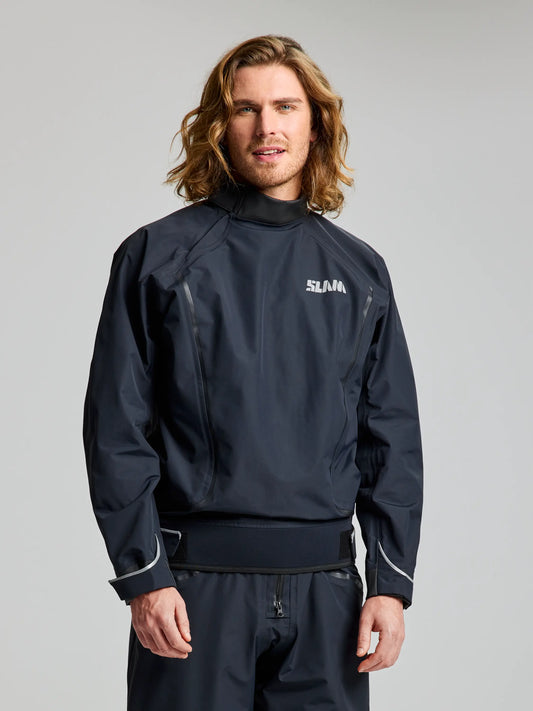
SLAM is at their side once again, with clothing designed to face humidity and tropical heat head-on. But theirs remains a sailor’s heart: respect for the sea, humility in the face of the power of the Atlantic, and that same determination we have come to recognise from their time on the Vendée. There is so much more to discover about the SLAM boats and crews, so don’t miss the next episode as we dive into the details!

The appeal of double-handed sailing

Double-handed sailing is based on operational trust: brief micro-sleeps, shared manoeuvres: everything is shared evenly, even mistakes. But insight is doubled. This is where technique and humanity collide: in seamanship, sensitivity and a passion for sailing. What was true in the Vendée Globe (a solo race) still rings true in pairs: only now there is a companion by your side, watching, understanding, completing your effort. So, the difference is not only in sharing the effort but in doubling the insight. The co-skipper becomes a mirror: they reflect your decisions, smooth out your mistakes, and keep up the pace when the other slows down. An essential language is born, made up of very few words and profound understanding. 

The origins of the Route du Café

In 1993, few responded to the call, but it was enough to define the character of the race: the Atlantic in autumn, headwinds, managing fatigue as a pair. The double-handed formula became an art: short shifts, an essential language, trust. 

2015, Gascony “corsé"

An edition etched into memory: two depressions lashed at the fleet, retirements, and masts and structures put to the test. It was the year that reminded everyone how important it is to know how to slow down in order to finish.

2017, a lesson in continuity

Jean-Pierre Dick claims his fourth personal victory (with Yann Eliès): it was not about just speed, but preparedness and reliability throughout the entire course to Brazil. 

2019, 7 participants retire out of 59

The ocean reminds us that it is alive: a leading IMOCA (Hugo Boss) hits a semi-submerged object and retires safely, MACSF runs aground and 5 Class 40s are forced to retire with two dismastings. Further south, the meteorological equator or ITCZ (Intertropical Convergence Zone, also known as Pot-au-Noir or doldrums) becomes a skill test: those who best read the sea and wind gain miles that count towards the finish. A “long and clean” route becomes a lesson.

2023, setting sail becomes part of the challenge

For the 30th anniversary, the weather dictates the rules: Storm Ciaran, with seafaring intelligence, forces the rescheduling of the departures of the 95 boats at the start. Exemplary management puts safety first, and the spectacle second. The message is clear: when it comes to the ocean, you win by choosing the moment, not forcing it.


Regresar al blog